Popular Posts

What’s Hot

Showing posts with label Gadgets News. Show all posts


a691dc9f704f48e7988d2e3e54ec5a4e
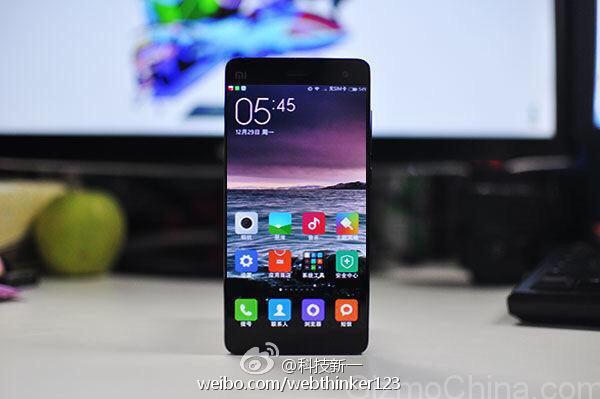
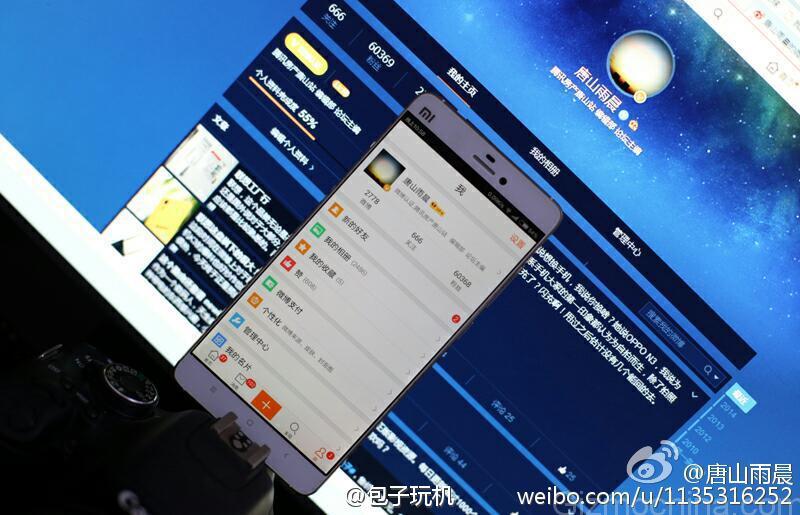
People are reporting  that Xiaomi will launch the Xiaomi Mi5 at CES 2015, and we had seen a Possible Xiaomi Mi5 white edition leak picture before, and today we found the possible Black Edition Xiaomi Mi5. The picture was spotted on Weibo shows a phone similar in appearance to the current Xiaomi Mi4, and it even has the Xiaomi logo and MIUI.
b4a56101jw1enivq0x85rj20m80ebq4k
Xiaomi’s Mi4 lead is a 5-inch telephone, But the gadget in this picture is a much bigger cell phone perhaps measuring between 5.5-inch and as much larger between 5.7-inch. We can see that the general look of Mi4 is held by this secret phone.  We can see from the picture that this phone has a very thin bezel, almost as thin as the earlier leaked black edition. But since it’s black, we can’t see the receiver, light sensor, camera and Xiaomi’s logo very clearly.
Rumors belive that this phone will run a 2k dispaly and pack a Snapdragon 805 with no less than 3gb RAM and offer 4G LTE. So is this the genuine Xiaomi Mi5 that is supposed to be shown at CES, or is this an artificially made picture from xiaomi mi4? What do you think about it after knowing some of its features?
Xiaomi Mi5 may not likely to be powered with snapdragon 810 cause Samsung Galaxy Note 4 S-LTE had taken it as the first one that powered with it!

Black Edition Xiaomi Mi5 Leaked?


a691dc9f704f48e7988d2e3e54ec5a4e
People are reporting  that Xiaomi will launch the Xiaomi Mi5 at CES 2015, and we had seen a Possible Xiaomi Mi5 white edition leak picture before, and today we found the possible Black Edition Xiaomi Mi5. The picture was spotted on Weibo shows a phone similar in appearance to the current Xiaomi Mi4, and it even has the Xiaomi logo and MIUI.
b4a56101jw1enivq0x85rj20m80ebq4k
Xiaomi’s Mi4 lead is a 5-inch telephone, But the gadget in this picture is a much bigger cell phone perhaps measuring between 5.5-inch and as much larger between 5.7-inch. We can see that the general look of Mi4 is held by this secret phone.  We can see from the picture that this phone has a very thin bezel, almost as thin as the earlier leaked black edition. But since it’s black, we can’t see the receiver, light sensor, camera and Xiaomi’s logo very clearly.
Rumors belive that this phone will run a 2k dispaly and pack a Snapdragon 805 with no less than 3gb RAM and offer 4G LTE. So is this the genuine Xiaomi Mi5 that is supposed to be shown at CES, or is this an artificially made picture from xiaomi mi4? What do you think about it after knowing some of its features?
Xiaomi Mi5 may not likely to be powered with snapdragon 810 cause Samsung Galaxy Note 4 S-LTE had taken it as the first one that powered with it!


(揭秘?泄露?研发中的联想K5手机音频实验室曝光_超清.mp4)[00.00.01.640](1)
In the last month of 2014, one of the leaders of PC and smartphone world, launched the first “Internet” phone – Lenovo K3, which was priced at an amazingly low 599 Yuan. That device had some music-centric aspects, but did not go too deep into hardware sound accelerations like Vivo or Meizu with their devices.
This time around it seems to be a bit different story as the company is ready to introduce a budget Hi-Fi device for music lovers.
According to the short clip, which was shot in Lenovo sound labs, Lenovo is putting a lot of effort to manufacture the Hi-Fi smartphone for a budget-friendly price. The company works hard to offer a consumer the best audio experience by integrating the hardware and software into their new Lenovo K5 device.
It seems to be a pretty great offering by the company as they are trying to catch up with the recent trend of Hi-Fi goodies packed in the smartphones, which was first started by the Hi-End smartphone manufacturer Vivo.
However, we are not aware of any other specs of this upcoming device. Still, we believe it would pack quite reasonable hardware for the price point. In the end, we think that the K5 device by the Lenovo will be a great addition to their already huge smartphone portfolio.

The Budget Hi-Fi Lenovo K5 Smartphone Leaks


(揭秘?泄露?研发中的联想K5手机音频实验室曝光_超清.mp4)[00.00.01.640](1)
In the last month of 2014, one of the leaders of PC and smartphone world, launched the first “Internet” phone – Lenovo K3, which was priced at an amazingly low 599 Yuan. That device had some music-centric aspects, but did not go too deep into hardware sound accelerations like Vivo or Meizu with their devices.
This time around it seems to be a bit different story as the company is ready to introduce a budget Hi-Fi device for music lovers.
According to the short clip, which was shot in Lenovo sound labs, Lenovo is putting a lot of effort to manufacture the Hi-Fi smartphone for a budget-friendly price. The company works hard to offer a consumer the best audio experience by integrating the hardware and software into their new Lenovo K5 device.
It seems to be a pretty great offering by the company as they are trying to catch up with the recent trend of Hi-Fi goodies packed in the smartphones, which was first started by the Hi-End smartphone manufacturer Vivo.
However, we are not aware of any other specs of this upcoming device. Still, we believe it would pack quite reasonable hardware for the price point. In the end, we think that the K5 device by the Lenovo will be a great addition to their already huge smartphone portfolio.

xiaomi_mi_laptop_leak.jpg
Xiaomi had an impressive year when it came to device sales across segments and markets, including the Indian market.
Now, a new leak tips that the company is gearing up to enter the PC segment with the launch of its first laptop. Gizmo China claims to have received some details of the configuration of the alleged Mi laptop alongside the purported pricing of the device.
According to the leaked details, the rumoured Xiaomi laptop will feature a large 15-inch display with a full-HD (1080p) resolution. The laptop is said to pack an Intel Haswell processor (Core i7-4500U) and feature two 8GB dual channel memory modules, which means it will pack a total of 16GB of RAM. The publication also claims that the Chinese brand will price its first laptop at as low as CNY 2,999 (Rs. 30,700 approximately).
The alleged Mi laptop has been also leaked in few images that show similar design aesthetics to Apple's Macbook Air range, featuring a similar colour scheme, bezel size, keyboard style, and other details.
The laptop is seen sporting 'Mi' branding just below the screen, while another logo is present at the back where the Apple logo would be engraved on Macbook Air laptops. The report speculates that the first Xiaomi laptop will run a "customised Linux OS".
So far, no announcement regarding Xiaomi's first laptop has been made by the Chinese company and we recommend our readers to take this leak with a pinch of salt as the its legitimacy remains questionable.
To recap, Xiaomi this year was claimed to be the third-largest mobile phone vendor in terms of smartphones sold replacing Huawei in the third quarter this year, according to a market research firm. It was shortly after ousted from this spot when Lenovo completed its acquisition of Motorola.
The company had also announced that its first fitness tracker, the Mi Band, enjoyed great success as the company shipped over 1 million units since the tracker went on sale on August 18.
Recently, Xiaomi India Head Manu Kumar Jain announced that the Chinese smartphone brand had crossed a major milestone in India this month - it had managed to sell 1 million smartphones in the country since its entry in July.

Alleged Xiaomi Macbook Air-Like Laptop Leaked in Images, Specifications

xiaomi_mi_laptop_leak.jpg
Xiaomi had an impressive year when it came to device sales across segments and markets, including the Indian market.
Now, a new leak tips that the company is gearing up to enter the PC segment with the launch of its first laptop. Gizmo China claims to have received some details of the configuration of the alleged Mi laptop alongside the purported pricing of the device.
According to the leaked details, the rumoured Xiaomi laptop will feature a large 15-inch display with a full-HD (1080p) resolution. The laptop is said to pack an Intel Haswell processor (Core i7-4500U) and feature two 8GB dual channel memory modules, which means it will pack a total of 16GB of RAM. The publication also claims that the Chinese brand will price its first laptop at as low as CNY 2,999 (Rs. 30,700 approximately).
The alleged Mi laptop has been also leaked in few images that show similar design aesthetics to Apple's Macbook Air range, featuring a similar colour scheme, bezel size, keyboard style, and other details.
The laptop is seen sporting 'Mi' branding just below the screen, while another logo is present at the back where the Apple logo would be engraved on Macbook Air laptops. The report speculates that the first Xiaomi laptop will run a "customised Linux OS".
So far, no announcement regarding Xiaomi's first laptop has been made by the Chinese company and we recommend our readers to take this leak with a pinch of salt as the its legitimacy remains questionable.
To recap, Xiaomi this year was claimed to be the third-largest mobile phone vendor in terms of smartphones sold replacing Huawei in the third quarter this year, according to a market research firm. It was shortly after ousted from this spot when Lenovo completed its acquisition of Motorola.
The company had also announced that its first fitness tracker, the Mi Band, enjoyed great success as the company shipped over 1 million units since the tracker went on sale on August 18.
Recently, Xiaomi India Head Manu Kumar Jain announced that the Chinese smartphone brand had crossed a major milestone in India this month - it had managed to sell 1 million smartphones in the country since its entry in July.

microsoft_lumia_535_screen.jpg
Microsoft, as expected, on Tuesday finally launched the first Lumia smartphone with its own branding, called the Microsoft Lumia 535.
The new Lumia smartphone from Microsoft will be available in two variants - single SIM (with the same name) and dual-SIM, called the Lumia 535 Dual SIM. The handset will be available starting November at an estimated recommended retail price of EUR 110 (roughly Rs. 8,400) before taxes and subsidies. The Microsoft Lumia 535 will first be available in countries such as China, Hong Kong and Bangladesh, with other countries to follow.
Announcing the news via the Lumia Conversations blog, Microsoft said, "Today sees the launch of the new Microsoft Lumia 535, our "5x5x5" smartphone package bringing a 5-inch screen, 5-megapixel front- and rear-facing camera, and free integrated Microsoft experiences (such as Skype and OneNote) to more people at an affordable price."
Both the Microsoft Lumia 535 and Lumia 535 Dual SIM come with identical specifications; except the latter features dual-SIM support. The smartphone runs Windows Phone 8.1 with Lumia Denim update and features a 5-inch IPS LCD display with a qHD (540x960 pixels) resolution and a pixel density of 220ppi. It also sports Corning Gorilla Glass 3 protection.
microsoft_lumia_535_skype_call.jpg
The Lumia 535 is powered by a quad-core Qualcomm Snapdragon 200 processor clocked at 1.2GHz alongside 1GB of RAM. There is 8GB of built-in storage that is further expandable via microSD card (up to 128GB). Much like other Lumia handsets, the Lumia 535 and Lumia 535 Dual SIM also get 15GB of free OneDrive cloud storage.
One of the highlight features of the Lumia 535 is the 5-megapixel front-facing camera, which is reminiscent of the Lumia 730 and Lumia 735. The company touts, "The Lumia 535 not only provides you with crystal-clear imagery and the Lumia selfie app, but you'll also be able to get more in shot during those Skype calls." It also sports a 5-megapixel rear camera with an LED flash.
Microsoft has announced that the Lumia 535, much like other Lumia handsets, will be available in Cyan, Bright Green, Bright Orange, White, Dark Grey, and Black colours.
The smartphone also supports Bluetooth LE and can connect to accessories such as the Portable Wireless Speaker and Coloud Bang among others.
Microsoft last month had announced that it would drop the Nokia name from its Lumia smartphones, continuing the rebranding following the acquisition of the Finnish company's handset division.


Microsoft-Branded Lumia 535 With 5-Megapixel Front Camera Launched

microsoft_lumia_535_screen.jpg
Microsoft, as expected, on Tuesday finally launched the first Lumia smartphone with its own branding, called the Microsoft Lumia 535.
The new Lumia smartphone from Microsoft will be available in two variants - single SIM (with the same name) and dual-SIM, called the Lumia 535 Dual SIM. The handset will be available starting November at an estimated recommended retail price of EUR 110 (roughly Rs. 8,400) before taxes and subsidies. The Microsoft Lumia 535 will first be available in countries such as China, Hong Kong and Bangladesh, with other countries to follow.
Announcing the news via the Lumia Conversations blog, Microsoft said, "Today sees the launch of the new Microsoft Lumia 535, our "5x5x5" smartphone package bringing a 5-inch screen, 5-megapixel front- and rear-facing camera, and free integrated Microsoft experiences (such as Skype and OneNote) to more people at an affordable price."
Both the Microsoft Lumia 535 and Lumia 535 Dual SIM come with identical specifications; except the latter features dual-SIM support. The smartphone runs Windows Phone 8.1 with Lumia Denim update and features a 5-inch IPS LCD display with a qHD (540x960 pixels) resolution and a pixel density of 220ppi. It also sports Corning Gorilla Glass 3 protection.
microsoft_lumia_535_skype_call.jpg
The Lumia 535 is powered by a quad-core Qualcomm Snapdragon 200 processor clocked at 1.2GHz alongside 1GB of RAM. There is 8GB of built-in storage that is further expandable via microSD card (up to 128GB). Much like other Lumia handsets, the Lumia 535 and Lumia 535 Dual SIM also get 15GB of free OneDrive cloud storage.
One of the highlight features of the Lumia 535 is the 5-megapixel front-facing camera, which is reminiscent of the Lumia 730 and Lumia 735. The company touts, "The Lumia 535 not only provides you with crystal-clear imagery and the Lumia selfie app, but you'll also be able to get more in shot during those Skype calls." It also sports a 5-megapixel rear camera with an LED flash.
Microsoft has announced that the Lumia 535, much like other Lumia handsets, will be available in Cyan, Bright Green, Bright Orange, White, Dark Grey, and Black colours.
The smartphone also supports Bluetooth LE and can connect to accessories such as the Portable Wireless Speaker and Coloud Bang among others.
Microsoft last month had announced that it would drop the Nokia name from its Lumia smartphones, continuing the rebranding following the acquisition of the Finnish company's handset division.


acer_aspire_e3-111_open_ndtv.jpg
The Acer Aspire E3-111 reminds us a little bit of the small, colourful netbooks that used to be so common in the market. It has been quite a while since Acer stopped manufacturing netbooks, which were originally intended for extremely price-conscious markets but ended up appealing to customers all over the world regardless of economic status. The entire product category might have been supplanted by tablets, but that doesn't mean there aren't still people who need affordable PCs.
With an 11.6-inch screen, the E3-111 is larger than most netbooks ever were, but it seems to be aimed at the same entry-level audience. It has very basic specifications and isn't going to be winning any performance prizes, but that's not what it's about. It's meant to be sturdy, with a balance of price and performance that will work for students, home users on a budget, and even those who need a cheap secondary PC for occasional use.
acer_aspire_e3-111_corner_ndtv.jpg
Look and feel
The Acer Aspire E3-111 is not super-slim but it does feel quite sleek and streamlined. The plastic body has smooth curves and is designed so that full-sized ports can fit on the back while the front tapers a bit. The whole thing looks great, and we could have been fooled into thinking we had a far more expensive device in our hands. Even the hinges are nicely sculpted into the body and don't stick out. When closed, the device fitted nicely into our hands and we had no problem carrying it around.
When open, you can see that there's enough room for a full-sized keyboard, though some of the keys are cramped. The layout is fairly standard, but we have to mention that a cluster of the alphabetical keys on the right side can double up as a numeric keypad if used with the Fn modifier - a quite useful feature, but one that's rare nowadays.
acer_aspire_e3-111_keyboard2_ndtv.jpg
The Aspire E3-111 weighs approximately 1.3kg and so you won't be too bothered by its weight in a bag. Our review unit had a pale blue body which stands out in comparison most other products in its class. The lid is a thin sheet of aluminium, though everything else is plastic. There are speakers on the bottom, angled outwards, and a webcam centred right above the screen.
If you're looking for fancy frills such as a backlit keyboard or a touchscreen, you'll have to keep on looking. Acer has covered all the basics, but there definitely are tradeoffs for such low prices.
The thing that surprised us most about the Aspire E3-111 was the lack of vents on the sides and rear of the chassis. Not many people will even notice this at first glance, but according to Acer, the device runs without any fans. That's a pretty great step forward - small tablets can get away with it, but we have higher expectations of a laptop such as this. Let's hope performance isn't too limited by components that don't require active cooling.
acer_aspire_e3-111_left_ndtv.jpg
Specifications
The various models in the Aspire E3-111 series are based on rather anaemic Intel Celeron and Pentium processors, based on the Bay Trail-M architecture which is derived from the same basic design that powers today's Atom CPUs. Our review unit, which was the Aspire E3-111-C37U model to be exact, was based on a Celeron N2840, which has a peak speed of 2.58GHz but will usually run closer to its base clock speed of 2.16GHz. It has two CPU cores without Hyper-Threading. The integrated Intel HD Graphics component is equally sedate, running at a top speed of 792MHz in bursts.
There's 2GB of RAM which is of the low-power DDR3L variety, but to keep costs low without compromising storage space, there's a traditional 500GB spinning hard drive. A solid-state drive would have been more consistent with the rest of the configuration and would have helped boost speeds quite a bit.
acer_aspire_e3-111_screen_ndtv.jpg
The screen is a simple 1366x768-pixel non-touch panel. Its glass does not have a glossy finish, which really stands out in the market today. Glossy, reflective surfaces often make colours appear more vibrant but are also often annoying because they reflect everything around them including light sources, and are impossible to keep free of smudges.
Wi-Fi b/g/n and Bluetooth 4.0 are supported, which is no surprise. The Aspire E3-111 also has more ports than some other slim laptops offer, though most of them are located on the rear, which is unusual. You might not mind that the Gigabit Ethernet and HDMI ports are tucked out of the way, but the sole USB 3.0 port and one of the two USB 2.0 ports are also consigned here, which can become annoying. The second USB 2.0 port is right at the back of the left edge, along with a single 3.5mm headset socket and an SD card reader. There's only a Kensington lock slot on the right. Students and BYOD office workers should note that there is no VGA port, which is often required to hook up laptops to projectors. 
The Aspire E3-111 runs Windows 8.1, though without a touchscreen to make it easier to navigate, some people will be a little unhappy. Acer preloads quite a bit of software including its own media and cloud storage utilities, a few third-party apps, and limited-time versions of Microsoft Office and McAfee LiveSafe Internet Security.
acer_aspire_e3-111_ports_ndtv.jpg
Performance
We weren't expecting much from the Celeron processor at the heart of this laptop, but we were still a little disappointed when the benchmark scores came in. Despite setting low expectations, the Acer Aspire E3-111 managed to surprise us with scores that barely kept up with other entry-level products. In some cases, the laptop performed worse than Atom-based tablets such as the Notion Ink Cain, although in other cases it did manage to match the far more expensive HP Pavilion 11 x360 with its Pentium processor.
PCMark 8 gave us 1633 and 2769 points in the Home (Accelerated) and Work test scenarios, which were both within a hair's breadth of the HP Pavilion 11 x360's scores. However, POVRay took 29 minutes, 23 seconds to render its test scene, compared to 16 minutes, 50 seconds and Cinebench R15's CPU test (multithreaded) gave us a score of 66 as opposed to 146. SiSoft SANDRA's CPU-intensive subtests also revealed a considerable gulf between the raw number-crunching abilities of the Celeron and Pentium processors. Considering the Pavilion 11 x360's swivel-touchscreen feature and much higher cost, we think Acer's approach is a little more balanced.
acer_aspire_e3-111_profile_ndtv.jpg
Thanks to its reliance on mechanical storage, the Aspire E3-111 falls behind even tablets with solid-state storage, such as the Notion Ink Cain. 3DMark failed to run, but browser-based tests including SunSpider and Browsermark were quite snappy.
Outside of formal benchmarks, there was quite a bit of lag and even occasional freezes which lasted about five seconds at a time when switching between windows. We weren't comfortable with more than a few programs and we definitely wouldn't want to rely on this device for even reasonably heavy task, such as editing images, while other things are also running.
We were happy to note that all our HD test videos except the heaviest MKV file played without stuttering. Audio quality was reasonably good, but there definitely was distortion at higher volumes. 
acer_aspire_e3-111_right_ndtv.jpg
The battery lasted an impressive 4 hours, 8 minutes in our Battery Eater Pro run. This is a fair bit higher than even some mainstream laptops can last, and is very impressive. We'd easily expect to get through a full working day on this laptop, which might just be its secret weapon - well worth the performance impact for many people.
The keyboard is comfortable, though a little stiff. The trackpad is almost a little too smooth, and we found our fingers slipping on it now and then. Still, it didn't take long to get used to both of them and we were comfortable within a day. The arrow keys are squashed together in an awkward rectangle, but that seems to be something all manufacturers are doing these days.
The non-reflective screen was a pleasure to work with. It's very unusual now to come across a device without shiny glass all over it, and the difference was immediately apparent to us. While some people will find it a little dull, we were happy with the tradeoff considering we didn't have to reposition the laptop dozens of times a day just to avoid reflections. Only the hinge doesn't go back as far as we would have liked.
acer_aspire_e3-111_rearangle_ndtv.jpg
We were also really curious to see how the Aspire E3-111 held up under heavy loads in terms of heat. We couldn't tell if the CPU was bring throttled very aggressively, but we did feel the bottom get warm when running intensive tests. It was enough to feel uncomfortable on our laps, but the good news is you're rarely, if ever, going to be doing things with this laptop that push it to such levels.
While the fanless design is nice and quiet, there's still a fair bit of vibration, most likely thanks to the spinning hard drive. All in all, we wouldn't have minded a few vents if had been possible to trade looks for better performance.
Verdict
It isn't just a simple matter of performance anymore - customers have loads of choices at the entry-level now, and no single type of product is necessarily better than any other. The Acer Aspire E3-111 is a good example of an entry-level laptop with no support for touch input, but a fairly good keyboard and a large hard drive for getting work done with. On the other hand, "2-in-1" tablets such as the Notion Ink Cain , which we just reviewed, also cost just about the same amount of money, but have very different advantages and disadvantages. If portability is the main concern, it's also seriously worth considering whether an iPad or Android tablet would serve your needs better.
acer_aspire_e3-111_top_ndtv.jpg
We aren't thrilled with Acer's latest product here. The stutters and freezes concern us and will definitely be frustrating to users, especially those who buy this device thinking it's as good as any conventional entry-level laptop. However, we do think that there will be plenty of people who really like the balance this device strikes between productivity and entertainment without raising costs.
If you're sure a tablet doesn't appeal to you, and if your needs don't go beyond the basics, you should be fine with the Aspire E3-111. You can type or edit Microsoft Office documents, read and respond to email messages, browsing the Web and social media, and watch a few movies - but remember that this is a netbook-class device, so don't try any gaming, heavy content editing, or any serious productive work.
Price (MRP): Rs. 22,999
Pros
  • Good looks and construction quality
  • Impressive battery life
  • Portable and affordable
Cons
  • Below-average performance
Ratings (Out of 5)
  • Design: 3.5
  • Display: 3.5
  • Performance: 2.5
  • Software: 3
  • Battery life: 4
  • Value for Money: 3
  • Overall: 3

Acer Aspire E3-111 Review: The New Netbook

acer_aspire_e3-111_open_ndtv.jpg
The Acer Aspire E3-111 reminds us a little bit of the small, colourful netbooks that used to be so common in the market. It has been quite a while since Acer stopped manufacturing netbooks, which were originally intended for extremely price-conscious markets but ended up appealing to customers all over the world regardless of economic status. The entire product category might have been supplanted by tablets, but that doesn't mean there aren't still people who need affordable PCs.
With an 11.6-inch screen, the E3-111 is larger than most netbooks ever were, but it seems to be aimed at the same entry-level audience. It has very basic specifications and isn't going to be winning any performance prizes, but that's not what it's about. It's meant to be sturdy, with a balance of price and performance that will work for students, home users on a budget, and even those who need a cheap secondary PC for occasional use.
acer_aspire_e3-111_corner_ndtv.jpg
Look and feel
The Acer Aspire E3-111 is not super-slim but it does feel quite sleek and streamlined. The plastic body has smooth curves and is designed so that full-sized ports can fit on the back while the front tapers a bit. The whole thing looks great, and we could have been fooled into thinking we had a far more expensive device in our hands. Even the hinges are nicely sculpted into the body and don't stick out. When closed, the device fitted nicely into our hands and we had no problem carrying it around.
When open, you can see that there's enough room for a full-sized keyboard, though some of the keys are cramped. The layout is fairly standard, but we have to mention that a cluster of the alphabetical keys on the right side can double up as a numeric keypad if used with the Fn modifier - a quite useful feature, but one that's rare nowadays.
acer_aspire_e3-111_keyboard2_ndtv.jpg
The Aspire E3-111 weighs approximately 1.3kg and so you won't be too bothered by its weight in a bag. Our review unit had a pale blue body which stands out in comparison most other products in its class. The lid is a thin sheet of aluminium, though everything else is plastic. There are speakers on the bottom, angled outwards, and a webcam centred right above the screen.
If you're looking for fancy frills such as a backlit keyboard or a touchscreen, you'll have to keep on looking. Acer has covered all the basics, but there definitely are tradeoffs for such low prices.
The thing that surprised us most about the Aspire E3-111 was the lack of vents on the sides and rear of the chassis. Not many people will even notice this at first glance, but according to Acer, the device runs without any fans. That's a pretty great step forward - small tablets can get away with it, but we have higher expectations of a laptop such as this. Let's hope performance isn't too limited by components that don't require active cooling.
acer_aspire_e3-111_left_ndtv.jpg
Specifications
The various models in the Aspire E3-111 series are based on rather anaemic Intel Celeron and Pentium processors, based on the Bay Trail-M architecture which is derived from the same basic design that powers today's Atom CPUs. Our review unit, which was the Aspire E3-111-C37U model to be exact, was based on a Celeron N2840, which has a peak speed of 2.58GHz but will usually run closer to its base clock speed of 2.16GHz. It has two CPU cores without Hyper-Threading. The integrated Intel HD Graphics component is equally sedate, running at a top speed of 792MHz in bursts.
There's 2GB of RAM which is of the low-power DDR3L variety, but to keep costs low without compromising storage space, there's a traditional 500GB spinning hard drive. A solid-state drive would have been more consistent with the rest of the configuration and would have helped boost speeds quite a bit.
acer_aspire_e3-111_screen_ndtv.jpg
The screen is a simple 1366x768-pixel non-touch panel. Its glass does not have a glossy finish, which really stands out in the market today. Glossy, reflective surfaces often make colours appear more vibrant but are also often annoying because they reflect everything around them including light sources, and are impossible to keep free of smudges.
Wi-Fi b/g/n and Bluetooth 4.0 are supported, which is no surprise. The Aspire E3-111 also has more ports than some other slim laptops offer, though most of them are located on the rear, which is unusual. You might not mind that the Gigabit Ethernet and HDMI ports are tucked out of the way, but the sole USB 3.0 port and one of the two USB 2.0 ports are also consigned here, which can become annoying. The second USB 2.0 port is right at the back of the left edge, along with a single 3.5mm headset socket and an SD card reader. There's only a Kensington lock slot on the right. Students and BYOD office workers should note that there is no VGA port, which is often required to hook up laptops to projectors. 
The Aspire E3-111 runs Windows 8.1, though without a touchscreen to make it easier to navigate, some people will be a little unhappy. Acer preloads quite a bit of software including its own media and cloud storage utilities, a few third-party apps, and limited-time versions of Microsoft Office and McAfee LiveSafe Internet Security.
acer_aspire_e3-111_ports_ndtv.jpg
Performance
We weren't expecting much from the Celeron processor at the heart of this laptop, but we were still a little disappointed when the benchmark scores came in. Despite setting low expectations, the Acer Aspire E3-111 managed to surprise us with scores that barely kept up with other entry-level products. In some cases, the laptop performed worse than Atom-based tablets such as the Notion Ink Cain, although in other cases it did manage to match the far more expensive HP Pavilion 11 x360 with its Pentium processor.
PCMark 8 gave us 1633 and 2769 points in the Home (Accelerated) and Work test scenarios, which were both within a hair's breadth of the HP Pavilion 11 x360's scores. However, POVRay took 29 minutes, 23 seconds to render its test scene, compared to 16 minutes, 50 seconds and Cinebench R15's CPU test (multithreaded) gave us a score of 66 as opposed to 146. SiSoft SANDRA's CPU-intensive subtests also revealed a considerable gulf between the raw number-crunching abilities of the Celeron and Pentium processors. Considering the Pavilion 11 x360's swivel-touchscreen feature and much higher cost, we think Acer's approach is a little more balanced.
acer_aspire_e3-111_profile_ndtv.jpg
Thanks to its reliance on mechanical storage, the Aspire E3-111 falls behind even tablets with solid-state storage, such as the Notion Ink Cain. 3DMark failed to run, but browser-based tests including SunSpider and Browsermark were quite snappy.
Outside of formal benchmarks, there was quite a bit of lag and even occasional freezes which lasted about five seconds at a time when switching between windows. We weren't comfortable with more than a few programs and we definitely wouldn't want to rely on this device for even reasonably heavy task, such as editing images, while other things are also running.
We were happy to note that all our HD test videos except the heaviest MKV file played without stuttering. Audio quality was reasonably good, but there definitely was distortion at higher volumes. 
acer_aspire_e3-111_right_ndtv.jpg
The battery lasted an impressive 4 hours, 8 minutes in our Battery Eater Pro run. This is a fair bit higher than even some mainstream laptops can last, and is very impressive. We'd easily expect to get through a full working day on this laptop, which might just be its secret weapon - well worth the performance impact for many people.
The keyboard is comfortable, though a little stiff. The trackpad is almost a little too smooth, and we found our fingers slipping on it now and then. Still, it didn't take long to get used to both of them and we were comfortable within a day. The arrow keys are squashed together in an awkward rectangle, but that seems to be something all manufacturers are doing these days.
The non-reflective screen was a pleasure to work with. It's very unusual now to come across a device without shiny glass all over it, and the difference was immediately apparent to us. While some people will find it a little dull, we were happy with the tradeoff considering we didn't have to reposition the laptop dozens of times a day just to avoid reflections. Only the hinge doesn't go back as far as we would have liked.
acer_aspire_e3-111_rearangle_ndtv.jpg
We were also really curious to see how the Aspire E3-111 held up under heavy loads in terms of heat. We couldn't tell if the CPU was bring throttled very aggressively, but we did feel the bottom get warm when running intensive tests. It was enough to feel uncomfortable on our laps, but the good news is you're rarely, if ever, going to be doing things with this laptop that push it to such levels.
While the fanless design is nice and quiet, there's still a fair bit of vibration, most likely thanks to the spinning hard drive. All in all, we wouldn't have minded a few vents if had been possible to trade looks for better performance.
Verdict
It isn't just a simple matter of performance anymore - customers have loads of choices at the entry-level now, and no single type of product is necessarily better than any other. The Acer Aspire E3-111 is a good example of an entry-level laptop with no support for touch input, but a fairly good keyboard and a large hard drive for getting work done with. On the other hand, "2-in-1" tablets such as the Notion Ink Cain , which we just reviewed, also cost just about the same amount of money, but have very different advantages and disadvantages. If portability is the main concern, it's also seriously worth considering whether an iPad or Android tablet would serve your needs better.
acer_aspire_e3-111_top_ndtv.jpg
We aren't thrilled with Acer's latest product here. The stutters and freezes concern us and will definitely be frustrating to users, especially those who buy this device thinking it's as good as any conventional entry-level laptop. However, we do think that there will be plenty of people who really like the balance this device strikes between productivity and entertainment without raising costs.
If you're sure a tablet doesn't appeal to you, and if your needs don't go beyond the basics, you should be fine with the Aspire E3-111. You can type or edit Microsoft Office documents, read and respond to email messages, browsing the Web and social media, and watch a few movies - but remember that this is a netbook-class device, so don't try any gaming, heavy content editing, or any serious productive work.
Price (MRP): Rs. 22,999
Pros
  • Good looks and construction quality
  • Impressive battery life
  • Portable and affordable
Cons
  • Below-average performance
Ratings (Out of 5)
  • Design: 3.5
  • Display: 3.5
  • Performance: 2.5
  • Software: 3
  • Battery life: 4
  • Value for Money: 3
  • Overall: 3

iMac_5K_Retina_front_tilt.jpg
Apple has introduced the 'Retina' terminology seen so far in the iPhone, iPad and MacBook Pro to its range of desktop all-in-one computers. The 27-inch iMac with Retina 5K display comes with a 5120x2880 display, which Apple is terming the "world's highest resolution display."

"Thirty years after the first Mac changed the world, the new iMac with Retina 5K display running OS X Yosemite is the most insanely great Mac we have ever made," said Philip Schiller, Apple's Senior Vice President of Worldwide Marketing. "With a breathtaking 14.7 million pixel display, faster CPU and graphics, Fusion Drive, and Thunderbolt 2, it's the most beautiful and powerful iMac ever."

iMac with Retina 5K display has four times more pixels than the standard 27-inch iMac and 67 percent more pixels than a 4K display. A single supercharged Apple-designed timing controller (TCON), with four times the bandwidth, drives all 14.7 million pixels. Apple says the iMac with Retina 5K display also uses highly efficient LEDs and organic passivation to "improve image quality and reduce display power consumption by 30 percent, even while driving four times more pixels at the same brightness."

For those who obsesses about colour accuracy, Apple claims the  iMac with Retina 5K display is "calibrated using three state-of-the-art spectroradiometers to ensure precise and accurate colour." Apple is also boosting of improved contrast ratio on the iMac with Retina 5K display.

While the highlight of iMac with Retina 5K display is of course the display, it is no slouch in terms of the other specifications. The iMac with Retina 5K display comes with a 3.5GHz quad-core Intel Core i5 processor with Turbo Boost speeds up to 3.9GHz, with an option to configure it with a 4GHz quad-core Intel Core i7 processor with Turbo Boost speeds up to 4.4GHz.

Every new iMac with Retina 5K display also comes with AMD Radeon R9 M290X graphics and can be configured with AMD Radeon R9 M295X graphics, delivering up to 3.5 teraflops of computing power.

iMac with Retina 5K display comes standard with 8GB of memory and a 1TB Fusion Drive, Apple terminology for the SSD + HDD hybrid. The new iMac can also be configured with up to 32GB of memory, a 3TB Fusion Drive, or up to 1TB of PCIe-based SSD storage. iMac with Retina 5K display includes two Thunderbolt 2 ports that deliver up to 20Gbps each, twice the bandwidth of the previous generation, 4 USB 3.0 ports, SDXC slot, Gigabit Ethernet, and a headphone slot.

The iMac with Retina 5K display comes with Apple Wireless Keyboard and Apple Magic Mouse.

Every new Mac comes with OS X Yosemite, which was officially released on Thursday. iMovie, GarageBand and the suite of iWork apps come free with every new Mac.

iMac with Retina 5K display can be ordered from select Apple Authorised Resellers starting next week. The 3.5GHz quad-core Intel Core i5 with Turbo Boost speeds up to 3.9GHz, AMD Radeon R9 M290X graphics and a 1TB Fusion Drive is priced at Rs. 1,79,900.

iMac With 27-Inch 5120x2880 'Retina 5K Display' Launched at Rs. 1,79,900

iMac_5K_Retina_front_tilt.jpg
Apple has introduced the 'Retina' terminology seen so far in the iPhone, iPad and MacBook Pro to its range of desktop all-in-one computers. The 27-inch iMac with Retina 5K display comes with a 5120x2880 display, which Apple is terming the "world's highest resolution display."

"Thirty years after the first Mac changed the world, the new iMac with Retina 5K display running OS X Yosemite is the most insanely great Mac we have ever made," said Philip Schiller, Apple's Senior Vice President of Worldwide Marketing. "With a breathtaking 14.7 million pixel display, faster CPU and graphics, Fusion Drive, and Thunderbolt 2, it's the most beautiful and powerful iMac ever."

iMac with Retina 5K display has four times more pixels than the standard 27-inch iMac and 67 percent more pixels than a 4K display. A single supercharged Apple-designed timing controller (TCON), with four times the bandwidth, drives all 14.7 million pixels. Apple says the iMac with Retina 5K display also uses highly efficient LEDs and organic passivation to "improve image quality and reduce display power consumption by 30 percent, even while driving four times more pixels at the same brightness."

For those who obsesses about colour accuracy, Apple claims the  iMac with Retina 5K display is "calibrated using three state-of-the-art spectroradiometers to ensure precise and accurate colour." Apple is also boosting of improved contrast ratio on the iMac with Retina 5K display.

While the highlight of iMac with Retina 5K display is of course the display, it is no slouch in terms of the other specifications. The iMac with Retina 5K display comes with a 3.5GHz quad-core Intel Core i5 processor with Turbo Boost speeds up to 3.9GHz, with an option to configure it with a 4GHz quad-core Intel Core i7 processor with Turbo Boost speeds up to 4.4GHz.

Every new iMac with Retina 5K display also comes with AMD Radeon R9 M290X graphics and can be configured with AMD Radeon R9 M295X graphics, delivering up to 3.5 teraflops of computing power.

iMac with Retina 5K display comes standard with 8GB of memory and a 1TB Fusion Drive, Apple terminology for the SSD + HDD hybrid. The new iMac can also be configured with up to 32GB of memory, a 3TB Fusion Drive, or up to 1TB of PCIe-based SSD storage. iMac with Retina 5K display includes two Thunderbolt 2 ports that deliver up to 20Gbps each, twice the bandwidth of the previous generation, 4 USB 3.0 ports, SDXC slot, Gigabit Ethernet, and a headphone slot.

The iMac with Retina 5K display comes with Apple Wireless Keyboard and Apple Magic Mouse.

Every new Mac comes with OS X Yosemite, which was officially released on Thursday. iMovie, GarageBand and the suite of iWork apps come free with every new Mac.

iMac with Retina 5K display can be ordered from select Apple Authorised Resellers starting next week. The 3.5GHz quad-core Intel Core i5 with Turbo Boost speeds up to 3.9GHz, AMD Radeon R9 M290X graphics and a 1TB Fusion Drive is priced at Rs. 1,79,900.

Samsung and LG unveil super-sized 105-inch Ultra HD televisions

Living rooms are in for a shock as LG and Samsung both announce the world's largest and curviest 105-inch Ultra ...
Living rooms are in for a shock as LG and Samsung both announce the world's largest and curviest 105-inch Ultra HD super televisions. Source: Supplied
EVERY January the cream of the tech world show off their shiny new wares at the Consumer Electronics Show - the biggest gadget event on the planet - and this year both companies will be elbowing each other for TV supremacy by unwrapping 105-inch Ultra HD curved sets.
LG began the TV battle by first announcing it will be revealing the "largest curved TV ever made", which is an LCD screen with a resolution of 5120 x 2160 (current Full HD screens are only 1920 x 1080) and a 21:9 aspect ratio that will look more like a cinema screen than a traditional home TV.
Samsung then quickly reacted by also proclaiming it would unveil "the world's first, largest and most curved 105-inch UHD TV" at the show.
This too will have the same resolution and aspect ratio as LG's beast but will adopt different picture processing.
Samsung's 105-incher is said to be the world's curv...
Samsung’s 105-incher is said to be the world’s curviest screen. Source: Supplied
In a Samsung blog it was revealed: "The Samsung 105-inch Curved UHD TV adopts a new proprietary picture quality algorithm that delivers optimised colour and greater feeling of depth. As the curved panel has been further upgraded and TV circuit technology has been added, the combination of the upgraded curved panel with a greater picture quality engine provides the ultimate immersive experience."
It also went on to talk about the curvature of the display: "As Samsung's 105" Curved UHD TV is the world's most curved, it provides almost two times vivid images when viewed from the side and the best possible TV viewing experience from any angle. Also, the 105 incher adopts 'Quadmatic Picture Engine' which delivers all content in UHD-level picture quality no matter what the source is."
Naturally, prices and release dates haven't been mentioned but anything less than $100,000 we'd be surprised.
We'll be bringing you more information on these super sets and other great gadget news from CES when it starts on January 7-10, 2014.

Samsung and LG unveil super-sized 105-inch Ultra HD televisions

Samsung and LG unveil super-sized 105-inch Ultra HD televisions

Living rooms are in for a shock as LG and Samsung both announce the world's largest and curviest 105-inch Ultra ...
Living rooms are in for a shock as LG and Samsung both announce the world's largest and curviest 105-inch Ultra HD super televisions. Source: Supplied
EVERY January the cream of the tech world show off their shiny new wares at the Consumer Electronics Show - the biggest gadget event on the planet - and this year both companies will be elbowing each other for TV supremacy by unwrapping 105-inch Ultra HD curved sets.
LG began the TV battle by first announcing it will be revealing the "largest curved TV ever made", which is an LCD screen with a resolution of 5120 x 2160 (current Full HD screens are only 1920 x 1080) and a 21:9 aspect ratio that will look more like a cinema screen than a traditional home TV.
Samsung then quickly reacted by also proclaiming it would unveil "the world's first, largest and most curved 105-inch UHD TV" at the show.
This too will have the same resolution and aspect ratio as LG's beast but will adopt different picture processing.
Samsung's 105-incher is said to be the world's curv...
Samsung’s 105-incher is said to be the world’s curviest screen. Source: Supplied
In a Samsung blog it was revealed: "The Samsung 105-inch Curved UHD TV adopts a new proprietary picture quality algorithm that delivers optimised colour and greater feeling of depth. As the curved panel has been further upgraded and TV circuit technology has been added, the combination of the upgraded curved panel with a greater picture quality engine provides the ultimate immersive experience."
It also went on to talk about the curvature of the display: "As Samsung's 105" Curved UHD TV is the world's most curved, it provides almost two times vivid images when viewed from the side and the best possible TV viewing experience from any angle. Also, the 105 incher adopts 'Quadmatic Picture Engine' which delivers all content in UHD-level picture quality no matter what the source is."
Naturally, prices and release dates haven't been mentioned but anything less than $100,000 we'd be surprised.
We'll be bringing you more information on these super sets and other great gadget news from CES when it starts on January 7-10, 2014.

Sony plays it straight with $20k, 85-inch 4K TV

Sony’s 85-inch Ultra HD X9500B comes with a $20,000 price tag.
Sony’s 85-inch Ultra HD X9500B comes with a $20,000 price tag. Source: Supplied
SOME TV makers say 2014 is the year of the curved TV but Sony has taken a different path.
The TV giant is backing 4K resolution and big displays as the way of the future — seriously big displays.
Sony’s top model is the 85-inch, Ultra HD X9500B, that comes with a $20,000 price tag.
Unlike other models in the Sony range, it does not have the strip of magnetic speakers down the side of the screen that are a feature of Sony’s new peak design wedge shape.
Instead, it offers a long duct speaker with an audio output of 40 watts, compared with the 65 watt audio power of the next model down (the X9000B).
Sony works on the reasonable assumption that if anyone is willing to pay $20,000 for a TV, they’re probably willing to pay extra for a surround-sound system.
The X9500B comes with a simple stand of two angled legs.
Sony plays it straight with $20k TV
If size matters the X9500B certainly measures up. Source: Supplied
A port replicator means a single fat cable runs inside the stand’s leg so you don’t have anything to take away from the visual impact of the screen.
And the visual impact is something to admire.
If this flagship can’t match other Sony models in audio output, it certainly outdoes them in picture quality.
The X9500B has Sony’s X-tended Dynamic Range Pro picture engine with direct LED backlight that gives it a brightness range three times that of a conventional LED LCD TV.
The X9500B, as is common with high-end TVs, comes with two remote controls. One is the standard remote, the other is Sony’s one-flick remote that has an attractive absence of buttons but it also takes some time to fully master.
I hooked the Sony up to a Blu-ray player to watch Harry Potter kick Voldemort’s butt, I hooked it up to a PlayStation, which allowed me to kick anyone’s butt, and I hooked it up to streaming services to watch the Tour de France kick a lot of cyclists’ butts.
The X9500B outperformed two rival 4K TVs in a side-by-side test.
The X9500B outperformed two rival 4K TVs in a side-by-side test. Source: Supplied
Sony calls its colour range Triluminos. We will call it the ability to show deep reds, rich greens and bright blues well, and it outperformed two rival 4K TVs in a side-by-side test.
We also hooked up a Sony Xperia Z2 smartphone to this television, using a MHL 3.0 cable, allowing the viewing of a 4K video shot on a 4K screen without the need for upscaling.
Television buyers are not going to be watching 4K home videos every day, but the smartphone camera delivers a rare source of pure 4K content.
Broadcast and streaming TV services are yet to deliver content that you don’t have to upscale to fully appreciate.
Should you rush out and buy this $20,000 4K TV?
The people who are asking themselves the question can probably afford not to even bother to ask.
Would you if you could?
Anyone asking this question is probably unable to afford the answer.
Some questions are too easy.
Bravia X9500B
$19,999, sony.com.au

Sony plays it straight with $20k, 85-inch 4K TV

Sony plays it straight with $20k, 85-inch 4K TV

Sony’s 85-inch Ultra HD X9500B comes with a $20,000 price tag.
Sony’s 85-inch Ultra HD X9500B comes with a $20,000 price tag. Source: Supplied
SOME TV makers say 2014 is the year of the curved TV but Sony has taken a different path.
The TV giant is backing 4K resolution and big displays as the way of the future — seriously big displays.
Sony’s top model is the 85-inch, Ultra HD X9500B, that comes with a $20,000 price tag.
Unlike other models in the Sony range, it does not have the strip of magnetic speakers down the side of the screen that are a feature of Sony’s new peak design wedge shape.
Instead, it offers a long duct speaker with an audio output of 40 watts, compared with the 65 watt audio power of the next model down (the X9000B).
Sony works on the reasonable assumption that if anyone is willing to pay $20,000 for a TV, they’re probably willing to pay extra for a surround-sound system.
The X9500B comes with a simple stand of two angled legs.
Sony plays it straight with $20k TV
If size matters the X9500B certainly measures up. Source: Supplied
A port replicator means a single fat cable runs inside the stand’s leg so you don’t have anything to take away from the visual impact of the screen.
And the visual impact is something to admire.
If this flagship can’t match other Sony models in audio output, it certainly outdoes them in picture quality.
The X9500B has Sony’s X-tended Dynamic Range Pro picture engine with direct LED backlight that gives it a brightness range three times that of a conventional LED LCD TV.
The X9500B, as is common with high-end TVs, comes with two remote controls. One is the standard remote, the other is Sony’s one-flick remote that has an attractive absence of buttons but it also takes some time to fully master.
I hooked the Sony up to a Blu-ray player to watch Harry Potter kick Voldemort’s butt, I hooked it up to a PlayStation, which allowed me to kick anyone’s butt, and I hooked it up to streaming services to watch the Tour de France kick a lot of cyclists’ butts.
The X9500B outperformed two rival 4K TVs in a side-by-side test.
The X9500B outperformed two rival 4K TVs in a side-by-side test. Source: Supplied
Sony calls its colour range Triluminos. We will call it the ability to show deep reds, rich greens and bright blues well, and it outperformed two rival 4K TVs in a side-by-side test.
We also hooked up a Sony Xperia Z2 smartphone to this television, using a MHL 3.0 cable, allowing the viewing of a 4K video shot on a 4K screen without the need for upscaling.
Television buyers are not going to be watching 4K home videos every day, but the smartphone camera delivers a rare source of pure 4K content.
Broadcast and streaming TV services are yet to deliver content that you don’t have to upscale to fully appreciate.
Should you rush out and buy this $20,000 4K TV?
The people who are asking themselves the question can probably afford not to even bother to ask.
Would you if you could?
Anyone asking this question is probably unable to afford the answer.
Some questions are too easy.
Bravia X9500B
$19,999, sony.com.au

Wow factor ... LG’s 65-inch 4K ultra high-definition OLED TV.


         Wow factor ... LG’s 65-inch 4K ultra high-definition OLED TV. Source: Supplied
AUSTRALIAN television audiences will be encouraged to upgrade their screens before Christmas, with LG revealing the country’s first Ultra High-Definition OLED models.
Australia will be one of just 10 countries in the world to receive the technology when it arrives in stores in the coming months, though a specific arrival date is yet to be set.
But the cutting-edge displays will not come cheaply, with the larger 77-inch breakthrough screen priced at $22,999, and the least expensive, a 65-inch screen, at $9,999.
LG Australia home entertainment marketing manager Grant Vandenberg said the South Korean company had a clear advantage being the only company selling organic light-emitting diode (OLED) screens after Samsung abandoned the advanced format this year.
Mr Vandenberg said LG was backing OLED technology as the “TV of the future” as it offered brighter colours, deeper blacks and higher contrast.
The big screen ... LG’s ultra high-definition OLED TV will be Australia’s first.
The big screen ... LG’s ultra high-definition OLED TV will be Australia’s first. Source: Supplied
“It is a lot of money but 4K OLED is for people who want the best technology in the market,” he said.
“You have to remember that 10 years ago, televisions were selling for the same price.”
The two Ultra High-Definition televisions will go on sale in selected stores alongside an upgraded, full high-definition, 55-inch curved OLED TV that last year launched at $11,999.
The TV will this year sell for just $3,999 -- a saving Mr Vandenberg put down to better manufacturing practices.
LG’s main rival, Samsung, kicked off the OLED television war in Australia in August last year, launching its first curved OLED screen for $10,999.
But the company has since stopped selling OLED television panels in favour of LED-backlit LCD screens with Ultra High-Definition resolution.
LG also revealed an even more expensive television at its harbourside launch, with a “whopping” 98-inch Ultra HD screen due in Australia before Christmas for $39,999.

LG’s ultra high-definition OLED TV coming to Australia, but price tag means it’s not for everyone

Wow factor ... LG’s 65-inch 4K ultra high-definition OLED TV.


         Wow factor ... LG’s 65-inch 4K ultra high-definition OLED TV. Source: Supplied
AUSTRALIAN television audiences will be encouraged to upgrade their screens before Christmas, with LG revealing the country’s first Ultra High-Definition OLED models.
Australia will be one of just 10 countries in the world to receive the technology when it arrives in stores in the coming months, though a specific arrival date is yet to be set.
But the cutting-edge displays will not come cheaply, with the larger 77-inch breakthrough screen priced at $22,999, and the least expensive, a 65-inch screen, at $9,999.
LG Australia home entertainment marketing manager Grant Vandenberg said the South Korean company had a clear advantage being the only company selling organic light-emitting diode (OLED) screens after Samsung abandoned the advanced format this year.
Mr Vandenberg said LG was backing OLED technology as the “TV of the future” as it offered brighter colours, deeper blacks and higher contrast.
The big screen ... LG’s ultra high-definition OLED TV will be Australia’s first.
The big screen ... LG’s ultra high-definition OLED TV will be Australia’s first. Source: Supplied
“It is a lot of money but 4K OLED is for people who want the best technology in the market,” he said.
“You have to remember that 10 years ago, televisions were selling for the same price.”
The two Ultra High-Definition televisions will go on sale in selected stores alongside an upgraded, full high-definition, 55-inch curved OLED TV that last year launched at $11,999.
The TV will this year sell for just $3,999 -- a saving Mr Vandenberg put down to better manufacturing practices.
LG’s main rival, Samsung, kicked off the OLED television war in Australia in August last year, launching its first curved OLED screen for $10,999.
But the company has since stopped selling OLED television panels in favour of LED-backlit LCD screens with Ultra High-Definition resolution.
LG also revealed an even more expensive television at its harbourside launch, with a “whopping” 98-inch Ultra HD screen due in Australia before Christmas for $39,999.

Nokia Lumia 920 review

The Lumia 920 dominated Nokia's presentation at Microsoft's Windows Phone 8 press event a few months ago, with the smaller Lumia 820 barely getting a look-in. It's got a "better-than-HD" 1,280 x 768, 4.5-inch high-contrast IPS display, built-in contactless charging, solid build quality and more of Nokia's exclusive software additions. This time, at least on hardware specifications, the company aims to put its flagship on equal footing with the likes of the Galaxy S III and the iPhone 5. Can Nokia's biggest and (literally) brightest smartphone maintain its place at top of the Windows Phone pile? How does that camera fare with extended use? And will the Lumia 920 offer enough to pull you away from Android or iOS for your next phone?It's been almost a year to the day since we reviewed Nokia's first Windows Phone and now we're staring at its second-generation flagship, the Lumia 920. Since theLumia 800, Nokia's taken a pretty big role in improving Windows Phone's standing in a crowded (but lucrative) smartphone battlefield. While it may be sharing the spotlight with the new HTC 8X, this slab of hewn polycarbonate has garnered plenty of admirers. No doubt, a large chunk of those would-be phone buyers are, for better and worse, lusting after the phone's PureView imaging tech -- and after our early tests, it looks like it could be just as impressive as the lossless optical zoom seen on the PureView 808.
GALLERY|40 PHOTOS

Nokia Lumia 920 review

GALLERY|30 PHOTOS

Nokia Lumia 920 review (AT&T model)


Nokia

Nokia Lumia 920

PROS
  • Rich display
  • Smooth video capture
  • Best-in-class low-light camera performance
CONS
  • Some softness in photos
  • Device feels unwieldy
  • App selection still lacking
  • Sluggish refresh on social networks
SUMMARY
It's Nokia's greatest Windows Phone yet. The Lumia 920 packs a superb screen with great visibility and sensitivity, but the camera gives a mixed performance.

    HARDWARE

    We'll be frank: Nokia has crafted one substantial smartphone. After experiencing the curves and lightness of HTC's Windows Phone 8X (4.5 ounces), the Lumia 920 makes the scales tremble at 6.5 ounces. While other phone makers are pushing the limits of lightweight materials and structures, this beast is noticeably heavier and feels bigger in comparison to almost every other recent phone. Granted, Nokia's Windows Phone flagship has a larger 4.5-inch screen, but that incremental difference (HTC's display is 4.3 inches wide) doesn't completely explain how different the two Windows Phones feel in-hand. Measuring the pair, the Lumia 920 is 0.42 inch thick to the 8X's 0.4 inch. Their footprints are also comparable. But the 8X's tapered edges felt more at home in our hands than this new Lumia. That said, we were able to reach the outer reaches of that PureMotion HD+ screen. What's more, despite that larger screen size, one-handed navigation is quite possible, though it might be a stretch for smaller hands.
    Thankfully, Nokia has carried across several design licks from the Lumia 800 and avoids one of the hardware design complaints we had with its bigger brother. Yep, this particular phone's screen curves into the frame and doesn't awkwardly protrude like the one found on the Lumia 900. Our white model -- unfortunately those eye-catching yellow and red models weren't available for review just yet -- has a glossy (but fingerprint- and smudge-prone) coating, but if you're looking for another matte-finish smartphone, thankfully the black AT&T LTE version has that shine-free look.
    DNP Nokia Lumia 920 review Something something PureView
    However, it's nonetheless another beautifully crafted smartphone from the Nokia design team, with tiny details like micro-drilled holes in the base for the pair of loudspeakers reminding you that this is a company that knows how to make desirable hardware -- even if the final product is a bit weighty. The rounded sides and that slightly curved back make this phone easier to grip than its predecessors. This time around, there's also a darker finish on both the rear camera unit and the physical buttons lined up on the right edge (update: these are actually ceramic and according to Nokia, will be less prone to scratches), while the flash is the only other detail on the otherwise smoothly curved back. Along the flat top edge, you'll find the pin-accessible micro-SIM slot (no nano-SIM just yet), some tiny perforations that connect to the secondary mic and headphone socket. The lower edge offers immediate access to the micro-USB port and the aforementioned two speakers.
    DNP Nokia Lumia 920 review Something something PureView
    Around front, the 920's 4.5-inch screen is underlined with a slightly thick bezel that houses the capacitive Windows button trio. These all light up and, as we'll also cover in the display section, they all work through your winter gloves or freshly manicured nails. Along the top of the screen, Nokia branding has this time been ushered to the right corner, with the earpiece housed above center of the screen. Both the ambient light sensor and a front-facing 1.2-megapixel camera take their place between the two. Underneath the screen, Nokia has installed Qi contactless charging for the phone's 2,000mAh battery. Our review model arrived with a contactless charging pad to test it out with, and it works exactly how it should, resting the majority of the phone on top of the pad will start it charging immediately, if slowly. The non-removable battery is tasked with powering a dual-core Snapdragon S4, alongside 1GB of RAM and a generous 32GB of storage. Microsoft's also throwing in 7GB of cloud storage for any new SkyDrive accounts and though it's quite possible you're already grandfathered into 25GB, there's no microSD slot for expanding the physical memory.
    As is to be expected, our global model crams in quad-band radios with GSM / GPRS / EDGE (850 / 900 / 1800 / 1900MHz), UMTS / HSPA+ (850 / 900 / 1900 / 2100MHz) and LTE (800 / 900 / 1800 / 2100 / 2600MHz) bands, while the device will launch exclusively on AT&T in the US, and only on (for now) EE in the UK -- the country's first 4G network. And if there's no 4G near you yet? Well DC-HSPA+ (42Mbps) is also stuffed inside that polycarbonate shell.

    DISPLAY

    The Lumia 920's screen packs so much new stuff from Nokia that they even wrote their own white paper on what's going on behind that sliver of curved glass -- we've linked to it at the bottom of this review. The 4.5-inch, 1,280 x 768 enhanced IPS screen is titled PureMotion HD+, and while the 332ppi means Windows Phone 8 looks crisp and images are superbly showcased, new technology here also improves the screen's transition response. While typical IPS LCDs have an average pixel transition time of 23ms, the Lumia 920 apparently trounces it with an average of 9ms. Can you tell the difference in real life? Well, barely -- we noticed reduced blur as we poked around the UI and swung the camera around. It's unlikely to be immediately noticeable to new smartphone users, but we can't fault Nokia for trying to push the envelope.
    Conversely, the Lumia 920's outdoor performance is a true selling point. While the Lumia 900 was no slouch in outdoor performance, the Windows Phone 8 sequel boosts contrast, brightness and color composition, meaning photos and websites are noticeably clearer -- and games and apps are easier to pilot under bright lights. Nokia has also improved its ambient light sensor, and we found the screen not only adjusted faster to lighting changes, but noticeably cranked up both color and contrast settings to improve viewing depending on whatever environment we were in. While November isn't the best time to test a phone's screen against full sunlight, we had no problems with the screen outdoors or under harsh show floor spotlights. These winter months, however, did prove ideal for steering the Synaptics-powered capacitive screen while wearing gloves, and the phone performed just as well as it did when it was first unveiled. The surface even picks up nails and some pens -- something we had no fear of testing ourselves thanks to the protection offered by a coating of Gorilla Glass.

    CAMERA

    Nokia Lumia 920 review Windows Phone 8 and a little bit of camera magic
    Where to start? Reading down the Lumia 920's spec sheet, there's plenty to get us excited: an 8.7-megapixel backside-illuminated sensor paired with an f/2.0 autofocus Carl Zeiss lens, the return of Nokia's PureView branding, the promise of superb low-light performance, 1080p video capture, and (on both stills and video) optical image stabilization -- the first floating lens and sensor in a phone that will ignore minor trembles while letting in more light. So after all that build up, does the Lumia 920 live up to that PureView appellation? Well, that's a little harder to say.
    Firstly, Nokia seems to be a bit limited as to how much it can bring to Windows Phone 8 camera UI. Load up the camera app (or hold the physical camera button) and you'll be greeted with a familiar camera interface -- it's simple, but a little sparse. Sure, compared to the all tweaks and options available to 808 PureView users, this might disappoint, but given that we were supremely impressed by that Symbian device's shots on auto, we weren't all that worried. Nokia's tried to amend this to some extent by adding its extra functionality through the Windows Phone 8's Lens system. Both from the Windows Phone marketplace (and from Nokia's own collection) you can install panorama functions, burst shot and even a GIF maker; these apps can be accessed both from the phone's program list and the arrow icon inside the camera UI.
    We got to work shooting samples and seeing how the Lumia 920 stacked up against both its PureView predecessor and current smartphone heavyweights. Throughout the course of our testing, we pitted Nokia's new Windows Phone against a number of other capable cameraphones, including the 808 PureView, the HTC One X+, Apple iPhone 5,Samsung Galaxy S II and Galaxy Note II and the LG Optimus G. We came into these testing scenarios with exceedingly high expectations, and in extremely low-light situations, where most phones fall flat on their face, the Lumia 920 indeed hit its stride. Yes, there was often some ISO noise to be seen and the results weren't always spectacular, but the 920's low-light shots were always the best of the bunch. Images were blur-free and reasonably clear, a definite improvement from the frequent messy quality induced by longer shutter times in the other cameras. Everything from contrast to color reproduction in low-light imagery was truly superior in the 920 to any other shooter we sampled it against, living up to Nokia's claims on that front.
    Unfortunately, the same can't be said for daytime photography. Here the tables were often turned, with the 920 frequently producing shots that were subtly soft. Different situations showed the problem more than others, but it was consistent across all shot types, whether macro or focusing on subjects farther away. We made doubly sure the lens was smudge-free and tested on four separate 920s to be sure, but on each we saw the same symptoms. It's as if the lens mechanism isn't quite focusing correctly. We spoke with Nokia at length about this and were told it's at least in part thanks to some pending software tweaks to increase sharpness -- but that doesn't explain why we didn't see any such aberrations when we visited Finland to test a 920 last month. This softness often resulted in some excess fuzziness in low-light too, but we found we could compensate by lowering the exposure settings to -1/3 or -2/3.
    That's not to say the daytime images looked bad, necessarily -- in fact they generally looked reasonably good. But in this case, the Lumia 920 failed to consistently deliver images that beat the rest. In fact, it was often the 920 that ranked mid-pack compared to the heavy-hitters we listed earlier. Another minor complaint was the white balance, often off in cloudy conditions outdoors (the 808 PureView had similar issues with fluorescents indoors), left some of our shots with a yellowish tinge -- the manual settings did remedy this, however.
    We look forward to testing the revised software on the device to see if it improves things, and we genuinely hope it does, but for now 920 shoppers may be forced to choose whether high-quality photography in the dark is truly enough to make up for occasionally middling performance when the sun is out. It's worth reiterating that the smartphone's image stabilization is a marvel, rescuing some shots we thought would be a blurry mess. It's another example of genuine innovation coming from Nokia -- but it's not quite there yet.
    We also found that the Lumia had difficulty metering the scenes we presented. We often had to decide between capturing a detailed skyline or a well-lit subject. An HDR mode certainly wouldn't go amiss. Admittedly, the low-light performance, as we'd already teased, beat everything else outright, but that performance has somehow cost your well-lit images a degree of detail you might not want to give up. We suggest take a look through our image gallery -- we were sure to run the camera phone through as many different environments as we could. Noise artifacts are low (again, especially in low light) and file sizes suggest that Nokia hasn't compressed much away. But we can't fight our disappointment with these results; after all that fanfare, the all-round imaging performance still leaves something to be desired.
    GALLERY|108 PHOTOS

    Nokia Lumia 920 sample shots

    GALLERY|44 PHOTOS

    Nokia 808 Pureview comparison sample shots

    GALLERY|39 PHOTOS

    Samsung Galaxy Note II comparison sample shots

    GALLERY|40 PHOTOS

    HTC One X+ comparison sample shots

    GALLERY|41 PHOTOS

    LG Optimus G (13MP) comparison sample shots

    GALLERY|7 PHOTOS

    Apple iPhone 5 comparison sample shots

    In better news, video capture is crisp and amazingly stable -- thanks to that OIS. Walking with the phone introduces minimal stutter -- especially compared to what we're used to on other smartphones, while autofocus is able to latch on to points of interest quickly. You'll make the prettiest video clips you've ever seen on smartphone, all lacking any motion sickness-inducing shuttering. As you might see in our samples, the phone often produced some slightly muted colors in our videos -- though we reckon this was still an accurate representation of the scene. Similarly, sometimes the auto-white balance would change in the middle of filming, meaning our videos would occasionally jump from warm yellows to cool blues and greens; something that would certainly benefit from some software adjustments.


    SOFTWARE

    DNP Nokia Lumia 920 review Something something PureView
    We'll leave the finer details of Windows Phone 8 to our in-depth review, but it's worth touching on how WP8 fares on the new Lumia. The slightly more customizable Live Tiles give you something to mess around with as soon as you switch it on -- and they still feel fresh, if only incrementally different from what we became accustomed to with Windows Phone 7. Covering some familiar software highlights; Nokia Maps is a superb app and free turn-by-turn navigation is hard to sniff at. Also, Internet Explorer 10 is swift, and looks sharp on the Lumia 920's high-response PureDisplay.
    GALLERY|57 PHOTOS

    Nokia Lumia 920 screenshots

    The Live Tiles are a common-sense setup and are easy to understand and adjust, while everything is largely organized in a sensible way. However, plenty of issues still remain; the lengthy refresh time for social apps like Twitter and Facebook, lightweight Google integration (which is admittedly better than what Microsoft's mobile OS offered in the past), and the jarring gap in app selection. While Microsoft was quick to claim it's catching up, the new iteration (at the time of this review) oddly lacks Spotify, already out on Windows Phone 7, while the likes of Dropbox, Instagram and Flipboard still remain absent.
    DNP Nokia Lumia 920 review Something something PureView
    The gaming selection, despite the Xbox Live connection, seems littered with titles of yesteryear and doesn't give mobile gamers enough to pull them away from the rich delights of both iOS and Android. Xbox SmartGlass replaces the My Xbox Live app, handing you another way to interact with your console. The full version requires an Xbox Live subscription (and a capable broadband connection), and throws up some touchscreen controls that map to controller buttons along with a content browser. SmartGlass-compatible content is signposted with its own icon, although unfortunately not all of it (notably Xbox Video) has been switched live just yet.
    We were able to connect to Netflix, but again, this requires a subscription. The contents don't appear to be fully fleshed-out yet -- presumably more contents will go live when the devices hit stores and while a keyboard is available when you browse through the phone, some parts of the Xbox UI still require typing through the UI -- and controller. We'd love to see further (possibly in-game) integration using Windows Phone as Microsoft continues to flesh out the feature -- because at the moment, there's not much here for us to do. We'll stick with the controller.
    DNP Nokia Lumia 920 review Something something PureView
    While our ecosystem complaints remain, Nokia has continued to offer its own "hero" apps, and even improved some of them in the process. Nokia Music continues to expand its music offering, despite obvious competition. The app itself now supports Dolby sound and has its own built-in seven-channel equalizer, while the gig finder feature now taps into location data for search results. The app will even spin out navigation results and the ability to buy tickets for your show of choice -- as long as they're still available. While anyone that's already signed up to Spotify, (or Pandora) will likely ignore the function, Mix radio still offers a raft of free (mainstream and not) music to stream and download, with the ability to take several playlists offline for use anywhere.
    Unsurprisingly, Nokia's included plenty of additional camera and imaging apps, ranging from the reality-augmenting City Lens, which was more than capable of leading us to the nearest cafe or pub across London, to the GIF-crafting skills of Cinemagraph. However, that last one feels like it isn't quite ready for public use just yet. After recording a brief clip, you can then select areas of the image to keep animated, while pausing the rest. This file can be then shared as a GIF file -- well, at least through a convoluted upload to SkyDrive.
    We were unable to get our animated pictures to send through email, Twitter or Facebook without the files being automatically converted to JPEG. In the end, the SkyDrive option does give you the animation, and even the chance to embed into your own blog, but it's a convoluted workflow for what could be a fun little extra. You'll also need a SkyDrive account just to see your uploaded pictures. Yep, Microsoft's cloud storage, while stitched into the very seams of the Windows Phone 8 is often rather unintuitive, especially when it comes to transferring pre-existing images to our phone. We just wanted to make the most of those photo tiles, but we found both the web and mobile side to the cloud storage system unclear and frustrating.

    PERFORMANCE AND BATTERY LIFE

    DNP Nokia Lumia 920 review Something something PureView
    Alongside that newer software comes fresher hardware -- and the arrival of dual cores on Windows Phone. The Lumia 920 packs a 1.5GHz Snapdragon S4 processor, meaning it's more than capable of breezing through transitions, content-dense websites and the current crop of available games. We've tested the phone on WPBench and AnTuTu, both Windows Phone 7 benchmarking apps that aren't calibrated for the latest version just yet. However, results line up with the HTC 8X and yet another impressive SunSpider score that's been borne out in our real-life experience with the handset; the device is more than capable of rendering the desktop versions of sites -- something that the big screen is also well-suited to.
    NOKIA LUMIA 920HTC WINDOWS PHONE 8XNOKIA LUMIA 900NOKIA LUMIA 800
    WPBench2272219286
    Battery rundown2:362:304:292:40
    SunSpider (ms, lower numbers are better)9149146,9027,200
    AnTuTu (*GFX test off)10,957*11,7752,5962,398
    It's also worth considering that the Lumia 920 has both a larger and slightly higher-resolution display than HTC's device, meaning the internals are being taxed a little more. Its battery, at least, is more substantial, at 2,000mAh, and in WPBench's CPU-taxing battery test (which is based on Windows Phone 7), we reached 2:36, incrementally more than the 8X. In typical use, the phone was more than able to keep up with a day's regular use, although we found that increased outdoor use (and thus a brighter screen) did make noticeable dents in the battery life. Using the Lumia 920's contactless charger was a bit slower than simply plugging it in, but that's what you pay for convenience. We're just glad to see the charging function arrive without a clunky case ruining a phone's design.

    WRAP-UP

    DNP Nokia Lumia 920 review Something something PureView
    Nokia arguably offered up the best hardware for the last iteration of Windows Phone. Does it repeat that success here? Yes, but it ties with the HTC 8X for that honor. The Lumia 920 feels substantially chunkier, despite having similar by-the-number dimensions, but it remains another glorious piece of hardware from Nokia. That large shell has afforded more space for the latest PureView camera, which delivers superb low-light performance and effective optical stabilization across stills and video. While these features worked as well as we'd hoped, well-lit shots lacked the clarity and detail we saw during earlier test sessions. Overall, results were a little too smoothed out (and many smartphones have a tendency to over-sharpen), and fell short of our expectations for Nokia's latest PureView phone.
    All your incredible shots of that great night out will also be tinged by SkyDrive frustrations and limited ways to share them -- something that Microsoft's mobile OS is going to have to deal with if they really want to become the third choice in smartphone operating systems. Meanwhile, alongside its imaging advances, Nokia has pushed forward on its screen hardware, besting the outdoor visibility of the Lumia 900 and adding color and contrast tweaks from a new ambient light sensor -- this is all on a capacitive touchscreen you can now handle with gloves on. Nokia may crown it the most innovative smartphone, and alongside embedded wireless charging, there's plenty here to demonstrate that. But, for all that Windows Phone 8 does right (superb maps, zippy browser, simplicity), those holes in the app selection remain something that needs to be plugged.
    Update 1: We've added our missing (conspiracy anyone?) gallery of iPhone 5 comparison shots, and here's a ZIP file containing most of our Lumia 920 images along with matching pictures taken with other cameraphones.

    Nokia Lumia 920 review: Windows Phone 8 and (a little bit of) camera magic

    Nokia Lumia 920 review

    The Lumia 920 dominated Nokia's presentation at Microsoft's Windows Phone 8 press event a few months ago, with the smaller Lumia 820 barely getting a look-in. It's got a "better-than-HD" 1,280 x 768, 4.5-inch high-contrast IPS display, built-in contactless charging, solid build quality and more of Nokia's exclusive software additions. This time, at least on hardware specifications, the company aims to put its flagship on equal footing with the likes of the Galaxy S III and the iPhone 5. Can Nokia's biggest and (literally) brightest smartphone maintain its place at top of the Windows Phone pile? How does that camera fare with extended use? And will the Lumia 920 offer enough to pull you away from Android or iOS for your next phone?It's been almost a year to the day since we reviewed Nokia's first Windows Phone and now we're staring at its second-generation flagship, the Lumia 920. Since theLumia 800, Nokia's taken a pretty big role in improving Windows Phone's standing in a crowded (but lucrative) smartphone battlefield. While it may be sharing the spotlight with the new HTC 8X, this slab of hewn polycarbonate has garnered plenty of admirers. No doubt, a large chunk of those would-be phone buyers are, for better and worse, lusting after the phone's PureView imaging tech -- and after our early tests, it looks like it could be just as impressive as the lossless optical zoom seen on the PureView 808.
    GALLERY|40 PHOTOS

    Nokia Lumia 920 review

    GALLERY|30 PHOTOS

    Nokia Lumia 920 review (AT&T model)


    Nokia

    Nokia Lumia 920

    PROS
    • Rich display
    • Smooth video capture
    • Best-in-class low-light camera performance
    CONS
    • Some softness in photos
    • Device feels unwieldy
    • App selection still lacking
    • Sluggish refresh on social networks
    SUMMARY
    It's Nokia's greatest Windows Phone yet. The Lumia 920 packs a superb screen with great visibility and sensitivity, but the camera gives a mixed performance.

      HARDWARE

      We'll be frank: Nokia has crafted one substantial smartphone. After experiencing the curves and lightness of HTC's Windows Phone 8X (4.5 ounces), the Lumia 920 makes the scales tremble at 6.5 ounces. While other phone makers are pushing the limits of lightweight materials and structures, this beast is noticeably heavier and feels bigger in comparison to almost every other recent phone. Granted, Nokia's Windows Phone flagship has a larger 4.5-inch screen, but that incremental difference (HTC's display is 4.3 inches wide) doesn't completely explain how different the two Windows Phones feel in-hand. Measuring the pair, the Lumia 920 is 0.42 inch thick to the 8X's 0.4 inch. Their footprints are also comparable. But the 8X's tapered edges felt more at home in our hands than this new Lumia. That said, we were able to reach the outer reaches of that PureMotion HD+ screen. What's more, despite that larger screen size, one-handed navigation is quite possible, though it might be a stretch for smaller hands.
      Thankfully, Nokia has carried across several design licks from the Lumia 800 and avoids one of the hardware design complaints we had with its bigger brother. Yep, this particular phone's screen curves into the frame and doesn't awkwardly protrude like the one found on the Lumia 900. Our white model -- unfortunately those eye-catching yellow and red models weren't available for review just yet -- has a glossy (but fingerprint- and smudge-prone) coating, but if you're looking for another matte-finish smartphone, thankfully the black AT&T LTE version has that shine-free look.
      DNP Nokia Lumia 920 review Something something PureView
      However, it's nonetheless another beautifully crafted smartphone from the Nokia design team, with tiny details like micro-drilled holes in the base for the pair of loudspeakers reminding you that this is a company that knows how to make desirable hardware -- even if the final product is a bit weighty. The rounded sides and that slightly curved back make this phone easier to grip than its predecessors. This time around, there's also a darker finish on both the rear camera unit and the physical buttons lined up on the right edge (update: these are actually ceramic and according to Nokia, will be less prone to scratches), while the flash is the only other detail on the otherwise smoothly curved back. Along the flat top edge, you'll find the pin-accessible micro-SIM slot (no nano-SIM just yet), some tiny perforations that connect to the secondary mic and headphone socket. The lower edge offers immediate access to the micro-USB port and the aforementioned two speakers.
      DNP Nokia Lumia 920 review Something something PureView
      Around front, the 920's 4.5-inch screen is underlined with a slightly thick bezel that houses the capacitive Windows button trio. These all light up and, as we'll also cover in the display section, they all work through your winter gloves or freshly manicured nails. Along the top of the screen, Nokia branding has this time been ushered to the right corner, with the earpiece housed above center of the screen. Both the ambient light sensor and a front-facing 1.2-megapixel camera take their place between the two. Underneath the screen, Nokia has installed Qi contactless charging for the phone's 2,000mAh battery. Our review model arrived with a contactless charging pad to test it out with, and it works exactly how it should, resting the majority of the phone on top of the pad will start it charging immediately, if slowly. The non-removable battery is tasked with powering a dual-core Snapdragon S4, alongside 1GB of RAM and a generous 32GB of storage. Microsoft's also throwing in 7GB of cloud storage for any new SkyDrive accounts and though it's quite possible you're already grandfathered into 25GB, there's no microSD slot for expanding the physical memory.
      As is to be expected, our global model crams in quad-band radios with GSM / GPRS / EDGE (850 / 900 / 1800 / 1900MHz), UMTS / HSPA+ (850 / 900 / 1900 / 2100MHz) and LTE (800 / 900 / 1800 / 2100 / 2600MHz) bands, while the device will launch exclusively on AT&T in the US, and only on (for now) EE in the UK -- the country's first 4G network. And if there's no 4G near you yet? Well DC-HSPA+ (42Mbps) is also stuffed inside that polycarbonate shell.

      DISPLAY

      The Lumia 920's screen packs so much new stuff from Nokia that they even wrote their own white paper on what's going on behind that sliver of curved glass -- we've linked to it at the bottom of this review. The 4.5-inch, 1,280 x 768 enhanced IPS screen is titled PureMotion HD+, and while the 332ppi means Windows Phone 8 looks crisp and images are superbly showcased, new technology here also improves the screen's transition response. While typical IPS LCDs have an average pixel transition time of 23ms, the Lumia 920 apparently trounces it with an average of 9ms. Can you tell the difference in real life? Well, barely -- we noticed reduced blur as we poked around the UI and swung the camera around. It's unlikely to be immediately noticeable to new smartphone users, but we can't fault Nokia for trying to push the envelope.
      Conversely, the Lumia 920's outdoor performance is a true selling point. While the Lumia 900 was no slouch in outdoor performance, the Windows Phone 8 sequel boosts contrast, brightness and color composition, meaning photos and websites are noticeably clearer -- and games and apps are easier to pilot under bright lights. Nokia has also improved its ambient light sensor, and we found the screen not only adjusted faster to lighting changes, but noticeably cranked up both color and contrast settings to improve viewing depending on whatever environment we were in. While November isn't the best time to test a phone's screen against full sunlight, we had no problems with the screen outdoors or under harsh show floor spotlights. These winter months, however, did prove ideal for steering the Synaptics-powered capacitive screen while wearing gloves, and the phone performed just as well as it did when it was first unveiled. The surface even picks up nails and some pens -- something we had no fear of testing ourselves thanks to the protection offered by a coating of Gorilla Glass.

      CAMERA

      Nokia Lumia 920 review Windows Phone 8 and a little bit of camera magic
      Where to start? Reading down the Lumia 920's spec sheet, there's plenty to get us excited: an 8.7-megapixel backside-illuminated sensor paired with an f/2.0 autofocus Carl Zeiss lens, the return of Nokia's PureView branding, the promise of superb low-light performance, 1080p video capture, and (on both stills and video) optical image stabilization -- the first floating lens and sensor in a phone that will ignore minor trembles while letting in more light. So after all that build up, does the Lumia 920 live up to that PureView appellation? Well, that's a little harder to say.
      Firstly, Nokia seems to be a bit limited as to how much it can bring to Windows Phone 8 camera UI. Load up the camera app (or hold the physical camera button) and you'll be greeted with a familiar camera interface -- it's simple, but a little sparse. Sure, compared to the all tweaks and options available to 808 PureView users, this might disappoint, but given that we were supremely impressed by that Symbian device's shots on auto, we weren't all that worried. Nokia's tried to amend this to some extent by adding its extra functionality through the Windows Phone 8's Lens system. Both from the Windows Phone marketplace (and from Nokia's own collection) you can install panorama functions, burst shot and even a GIF maker; these apps can be accessed both from the phone's program list and the arrow icon inside the camera UI.
      We got to work shooting samples and seeing how the Lumia 920 stacked up against both its PureView predecessor and current smartphone heavyweights. Throughout the course of our testing, we pitted Nokia's new Windows Phone against a number of other capable cameraphones, including the 808 PureView, the HTC One X+, Apple iPhone 5,Samsung Galaxy S II and Galaxy Note II and the LG Optimus G. We came into these testing scenarios with exceedingly high expectations, and in extremely low-light situations, where most phones fall flat on their face, the Lumia 920 indeed hit its stride. Yes, there was often some ISO noise to be seen and the results weren't always spectacular, but the 920's low-light shots were always the best of the bunch. Images were blur-free and reasonably clear, a definite improvement from the frequent messy quality induced by longer shutter times in the other cameras. Everything from contrast to color reproduction in low-light imagery was truly superior in the 920 to any other shooter we sampled it against, living up to Nokia's claims on that front.
      Unfortunately, the same can't be said for daytime photography. Here the tables were often turned, with the 920 frequently producing shots that were subtly soft. Different situations showed the problem more than others, but it was consistent across all shot types, whether macro or focusing on subjects farther away. We made doubly sure the lens was smudge-free and tested on four separate 920s to be sure, but on each we saw the same symptoms. It's as if the lens mechanism isn't quite focusing correctly. We spoke with Nokia at length about this and were told it's at least in part thanks to some pending software tweaks to increase sharpness -- but that doesn't explain why we didn't see any such aberrations when we visited Finland to test a 920 last month. This softness often resulted in some excess fuzziness in low-light too, but we found we could compensate by lowering the exposure settings to -1/3 or -2/3.
      That's not to say the daytime images looked bad, necessarily -- in fact they generally looked reasonably good. But in this case, the Lumia 920 failed to consistently deliver images that beat the rest. In fact, it was often the 920 that ranked mid-pack compared to the heavy-hitters we listed earlier. Another minor complaint was the white balance, often off in cloudy conditions outdoors (the 808 PureView had similar issues with fluorescents indoors), left some of our shots with a yellowish tinge -- the manual settings did remedy this, however.
      We look forward to testing the revised software on the device to see if it improves things, and we genuinely hope it does, but for now 920 shoppers may be forced to choose whether high-quality photography in the dark is truly enough to make up for occasionally middling performance when the sun is out. It's worth reiterating that the smartphone's image stabilization is a marvel, rescuing some shots we thought would be a blurry mess. It's another example of genuine innovation coming from Nokia -- but it's not quite there yet.
      We also found that the Lumia had difficulty metering the scenes we presented. We often had to decide between capturing a detailed skyline or a well-lit subject. An HDR mode certainly wouldn't go amiss. Admittedly, the low-light performance, as we'd already teased, beat everything else outright, but that performance has somehow cost your well-lit images a degree of detail you might not want to give up. We suggest take a look through our image gallery -- we were sure to run the camera phone through as many different environments as we could. Noise artifacts are low (again, especially in low light) and file sizes suggest that Nokia hasn't compressed much away. But we can't fight our disappointment with these results; after all that fanfare, the all-round imaging performance still leaves something to be desired.
      GALLERY|108 PHOTOS

      Nokia Lumia 920 sample shots

      GALLERY|44 PHOTOS

      Nokia 808 Pureview comparison sample shots

      GALLERY|39 PHOTOS

      Samsung Galaxy Note II comparison sample shots

      GALLERY|40 PHOTOS

      HTC One X+ comparison sample shots

      GALLERY|41 PHOTOS

      LG Optimus G (13MP) comparison sample shots

      GALLERY|7 PHOTOS

      Apple iPhone 5 comparison sample shots

      In better news, video capture is crisp and amazingly stable -- thanks to that OIS. Walking with the phone introduces minimal stutter -- especially compared to what we're used to on other smartphones, while autofocus is able to latch on to points of interest quickly. You'll make the prettiest video clips you've ever seen on smartphone, all lacking any motion sickness-inducing shuttering. As you might see in our samples, the phone often produced some slightly muted colors in our videos -- though we reckon this was still an accurate representation of the scene. Similarly, sometimes the auto-white balance would change in the middle of filming, meaning our videos would occasionally jump from warm yellows to cool blues and greens; something that would certainly benefit from some software adjustments.


      SOFTWARE

      DNP Nokia Lumia 920 review Something something PureView
      We'll leave the finer details of Windows Phone 8 to our in-depth review, but it's worth touching on how WP8 fares on the new Lumia. The slightly more customizable Live Tiles give you something to mess around with as soon as you switch it on -- and they still feel fresh, if only incrementally different from what we became accustomed to with Windows Phone 7. Covering some familiar software highlights; Nokia Maps is a superb app and free turn-by-turn navigation is hard to sniff at. Also, Internet Explorer 10 is swift, and looks sharp on the Lumia 920's high-response PureDisplay.
      GALLERY|57 PHOTOS

      Nokia Lumia 920 screenshots

      The Live Tiles are a common-sense setup and are easy to understand and adjust, while everything is largely organized in a sensible way. However, plenty of issues still remain; the lengthy refresh time for social apps like Twitter and Facebook, lightweight Google integration (which is admittedly better than what Microsoft's mobile OS offered in the past), and the jarring gap in app selection. While Microsoft was quick to claim it's catching up, the new iteration (at the time of this review) oddly lacks Spotify, already out on Windows Phone 7, while the likes of Dropbox, Instagram and Flipboard still remain absent.
      DNP Nokia Lumia 920 review Something something PureView
      The gaming selection, despite the Xbox Live connection, seems littered with titles of yesteryear and doesn't give mobile gamers enough to pull them away from the rich delights of both iOS and Android. Xbox SmartGlass replaces the My Xbox Live app, handing you another way to interact with your console. The full version requires an Xbox Live subscription (and a capable broadband connection), and throws up some touchscreen controls that map to controller buttons along with a content browser. SmartGlass-compatible content is signposted with its own icon, although unfortunately not all of it (notably Xbox Video) has been switched live just yet.
      We were able to connect to Netflix, but again, this requires a subscription. The contents don't appear to be fully fleshed-out yet -- presumably more contents will go live when the devices hit stores and while a keyboard is available when you browse through the phone, some parts of the Xbox UI still require typing through the UI -- and controller. We'd love to see further (possibly in-game) integration using Windows Phone as Microsoft continues to flesh out the feature -- because at the moment, there's not much here for us to do. We'll stick with the controller.
      DNP Nokia Lumia 920 review Something something PureView
      While our ecosystem complaints remain, Nokia has continued to offer its own "hero" apps, and even improved some of them in the process. Nokia Music continues to expand its music offering, despite obvious competition. The app itself now supports Dolby sound and has its own built-in seven-channel equalizer, while the gig finder feature now taps into location data for search results. The app will even spin out navigation results and the ability to buy tickets for your show of choice -- as long as they're still available. While anyone that's already signed up to Spotify, (or Pandora) will likely ignore the function, Mix radio still offers a raft of free (mainstream and not) music to stream and download, with the ability to take several playlists offline for use anywhere.
      Unsurprisingly, Nokia's included plenty of additional camera and imaging apps, ranging from the reality-augmenting City Lens, which was more than capable of leading us to the nearest cafe or pub across London, to the GIF-crafting skills of Cinemagraph. However, that last one feels like it isn't quite ready for public use just yet. After recording a brief clip, you can then select areas of the image to keep animated, while pausing the rest. This file can be then shared as a GIF file -- well, at least through a convoluted upload to SkyDrive.
      We were unable to get our animated pictures to send through email, Twitter or Facebook without the files being automatically converted to JPEG. In the end, the SkyDrive option does give you the animation, and even the chance to embed into your own blog, but it's a convoluted workflow for what could be a fun little extra. You'll also need a SkyDrive account just to see your uploaded pictures. Yep, Microsoft's cloud storage, while stitched into the very seams of the Windows Phone 8 is often rather unintuitive, especially when it comes to transferring pre-existing images to our phone. We just wanted to make the most of those photo tiles, but we found both the web and mobile side to the cloud storage system unclear and frustrating.

      PERFORMANCE AND BATTERY LIFE

      DNP Nokia Lumia 920 review Something something PureView
      Alongside that newer software comes fresher hardware -- and the arrival of dual cores on Windows Phone. The Lumia 920 packs a 1.5GHz Snapdragon S4 processor, meaning it's more than capable of breezing through transitions, content-dense websites and the current crop of available games. We've tested the phone on WPBench and AnTuTu, both Windows Phone 7 benchmarking apps that aren't calibrated for the latest version just yet. However, results line up with the HTC 8X and yet another impressive SunSpider score that's been borne out in our real-life experience with the handset; the device is more than capable of rendering the desktop versions of sites -- something that the big screen is also well-suited to.
      NOKIA LUMIA 920HTC WINDOWS PHONE 8XNOKIA LUMIA 900NOKIA LUMIA 800
      WPBench2272219286
      Battery rundown2:362:304:292:40
      SunSpider (ms, lower numbers are better)9149146,9027,200
      AnTuTu (*GFX test off)10,957*11,7752,5962,398
      It's also worth considering that the Lumia 920 has both a larger and slightly higher-resolution display than HTC's device, meaning the internals are being taxed a little more. Its battery, at least, is more substantial, at 2,000mAh, and in WPBench's CPU-taxing battery test (which is based on Windows Phone 7), we reached 2:36, incrementally more than the 8X. In typical use, the phone was more than able to keep up with a day's regular use, although we found that increased outdoor use (and thus a brighter screen) did make noticeable dents in the battery life. Using the Lumia 920's contactless charger was a bit slower than simply plugging it in, but that's what you pay for convenience. We're just glad to see the charging function arrive without a clunky case ruining a phone's design.

      WRAP-UP

      DNP Nokia Lumia 920 review Something something PureView
      Nokia arguably offered up the best hardware for the last iteration of Windows Phone. Does it repeat that success here? Yes, but it ties with the HTC 8X for that honor. The Lumia 920 feels substantially chunkier, despite having similar by-the-number dimensions, but it remains another glorious piece of hardware from Nokia. That large shell has afforded more space for the latest PureView camera, which delivers superb low-light performance and effective optical stabilization across stills and video. While these features worked as well as we'd hoped, well-lit shots lacked the clarity and detail we saw during earlier test sessions. Overall, results were a little too smoothed out (and many smartphones have a tendency to over-sharpen), and fell short of our expectations for Nokia's latest PureView phone.
      All your incredible shots of that great night out will also be tinged by SkyDrive frustrations and limited ways to share them -- something that Microsoft's mobile OS is going to have to deal with if they really want to become the third choice in smartphone operating systems. Meanwhile, alongside its imaging advances, Nokia has pushed forward on its screen hardware, besting the outdoor visibility of the Lumia 900 and adding color and contrast tweaks from a new ambient light sensor -- this is all on a capacitive touchscreen you can now handle with gloves on. Nokia may crown it the most innovative smartphone, and alongside embedded wireless charging, there's plenty here to demonstrate that. But, for all that Windows Phone 8 does right (superb maps, zippy browser, simplicity), those holes in the app selection remain something that needs to be plugged.
      Update 1: We've added our missing (conspiracy anyone?) gallery of iPhone 5 comparison shots, and here's a ZIP file containing most of our Lumia 920 images along with matching pictures taken with other cameraphones.